
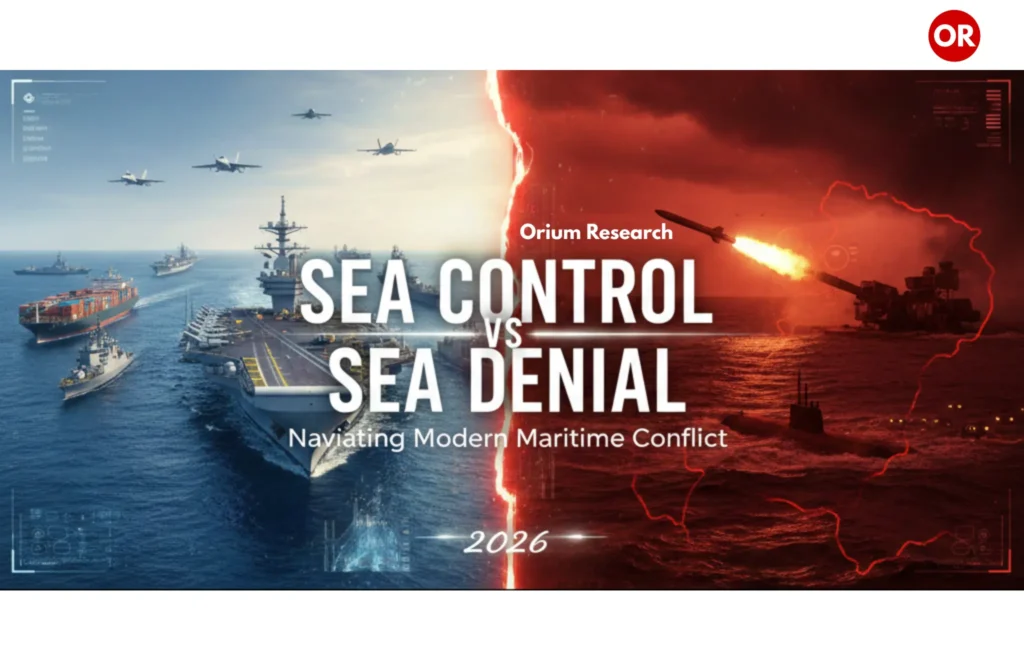
Have you ever wondered what Sea Control vs Sea Denial actually is? Have you ever looked at a map of the world’s oceans and wondered: Who actually owns this? If you follow the news about the South China Sea, the Black Sea, or the Red Sea, you’ll notice that despite our billion-dollar satellites and AI-guided missiles, we are still fighting over the same concepts naval officers debated 150 years ago.
We’re talking about Sea Control vs Sea Denial.
But here is the real question: In an era of “cheap” suicide drones and invisible cyber warfare, does having the biggest Navy even matter anymore? Let’s dive into why the old rules are being rewritten in real-time.
The Power Move: What is Sea Control?
Think of Sea Control as “owning the road.” If you have it, you can move your ships, your trade, and your troops wherever you want.
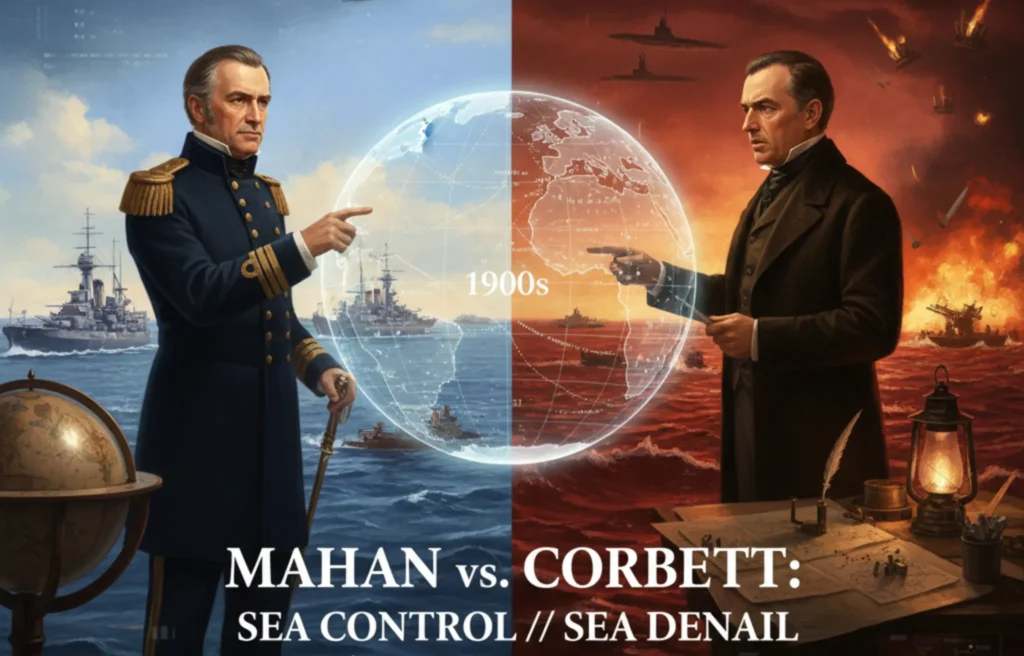
Classic theorists like Alfred Thayer Mahan argued that if you want to be a superpower, you must command the sea. But let’s be honest, can anyone truly “command” the ocean in 2026? Today, sea control isn’t a permanent state; it’s a temporary window of safety that you have to fight for every single hour. Hence, it’s important to understand the fight between Sea Control vs Sea Denial
The Disruptor: Why Sea Denial is Changing the Game
Now, what if you aren’t a superpower? What if you’re the “underdog”? That’s where Sea Denial comes in. You don’t need to own the road; you just need to make sure your enemy can’t use it.
By using mines, submarines, and long-range missiles, what the experts call A2/AD (Anti-Access/Area Denial)—smaller forces are making it “too expensive” for big navies to stick around.
Think about this: Does it make sense to risk a $2 billion destroyer against a swarm of drones that cost less than a used car? That is the brutal reality of modern sea denial. It’s not about winning a fair fight; it’s about making the ocean a “no-go zone.”
The Asymmetric Shift: Sea Control vs Sea Denial in 2026
As we move further into 2026, the traditional divide between Sea Control vs Sea Denial has become increasingly blurred by “all-domain” warfare. While classical naval theory once treated these as separate phases of a conflict, modern technology has forced them to overlap.
For instance, look at the current situation in the South China Sea and the Black Sea. Superior naval powers are finding that maintaining absolute Sea Control is nearly impossible when faced with advanced A2/AD (Anti-Access/Area Denial) networks. These networks, powered by land-based anti-ship missiles and AI-driven drone swarms, allow smaller forces to execute a high-impact Sea Denial strategy without ever needing to launch a single destroyer.
Why the Global Economy is the Real Battlefield
Is Classical Theory Still Relevant?
You might ask, “Why are we still talking about guys like Mahan and Julian Corbett?” Why are we still talking about Sea Control vs Sea Denial
Because while the tools have changed, the intent hasn’t. Whether it’s a wooden ship or a nuclear carrier, the goal is the same: protecting the “arteries” of global trade. If the sea lanes stop moving, the world stops eating. It’s that simple.
As we look at contemporary maritime conflicts, we see a shift. We are moving away from “Total Command” toward a world of Contested Seas. It’s a messy, high-stakes game of cat and mouse where the rules are being written in salt and steel.
Want to Dive Deeper?
If you’re interested in the academic side of this strategy or want to see the specific historical breakdown, you should definitely check out the original analysis:
- Read the Full Paper: Sea Control vs. Sea Denial at IndoNeeti – This provides the deep-dive context that inspired this discussion.
- Business & Logistics: For insights on how maritime security affects global trade routes and business operations, keep visiting Oriumresearch.com
What do you think? Is the age of the Great Navy over, or are we just seeing the next evolution of Sea Control? Let’s talk about it in the comments.